
Methodology
This project assembles a structured dataset of V-weapon impacts in Belgium during 1944–1945. The data is processed through a reproducible pipeline so that each record can be traced from its raw source to the final map displayed on this website.
Rather than manually compiling a single list, the dataset is generated through a series of transformation steps. Each phase produces intermediate files and quality-assurance reports, allowing the dataset to be reviewed and corrected as it evolves.
Source Data
The initial dataset consists of multiple historical collections of V-weapon impacts. These sources contain varying formats, languages, and levels of detail. Some records include narrative descriptions, while others contain only dates or coordinates.
Because the source materials differ in structure, the first stage of the project focuses on normalization and schema alignment before any interpretation or enrichment occurs.
Pipeline Processing
All records are processed through a scripted pipeline that converts raw data into a consistent event format. Each stage performs a specific transformation so that the resulting dataset remains transparent and reproducible.
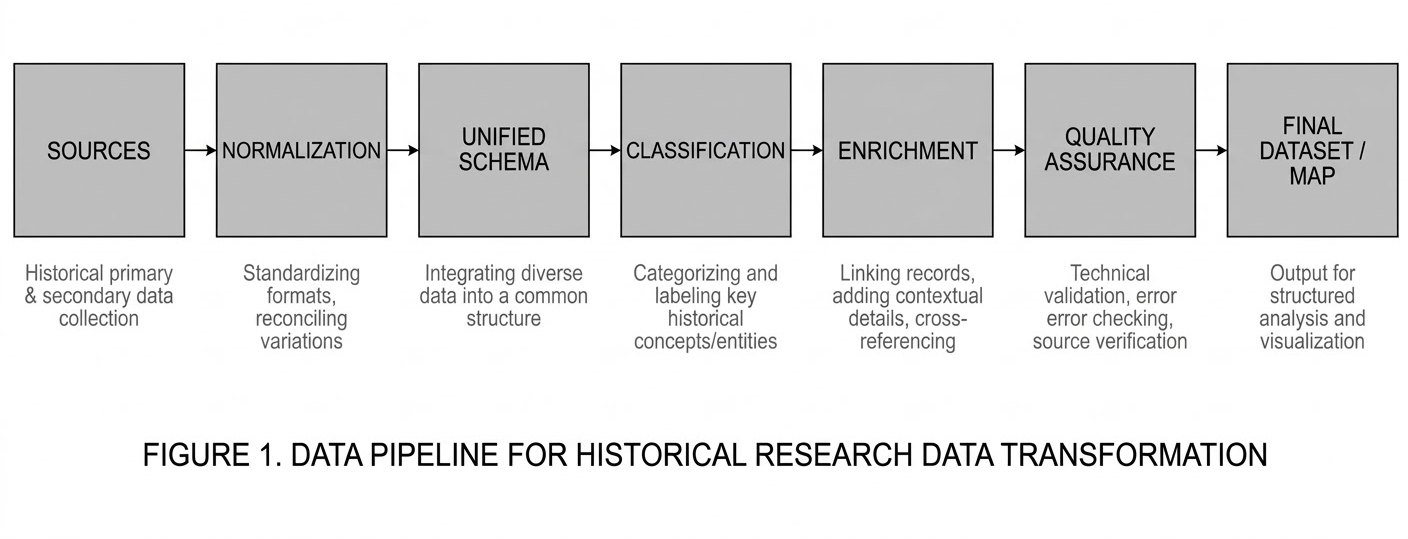
1. Source Normalization
Raw GeoJSON datasets are loaded and normalized. Text fields are cleaned and converted to a consistent structure, and malformed or embedded HTML fragments are simplified into plain text.
2. Unified Event Schema
Every impact event is converted into a shared schema containing standard fields such as:
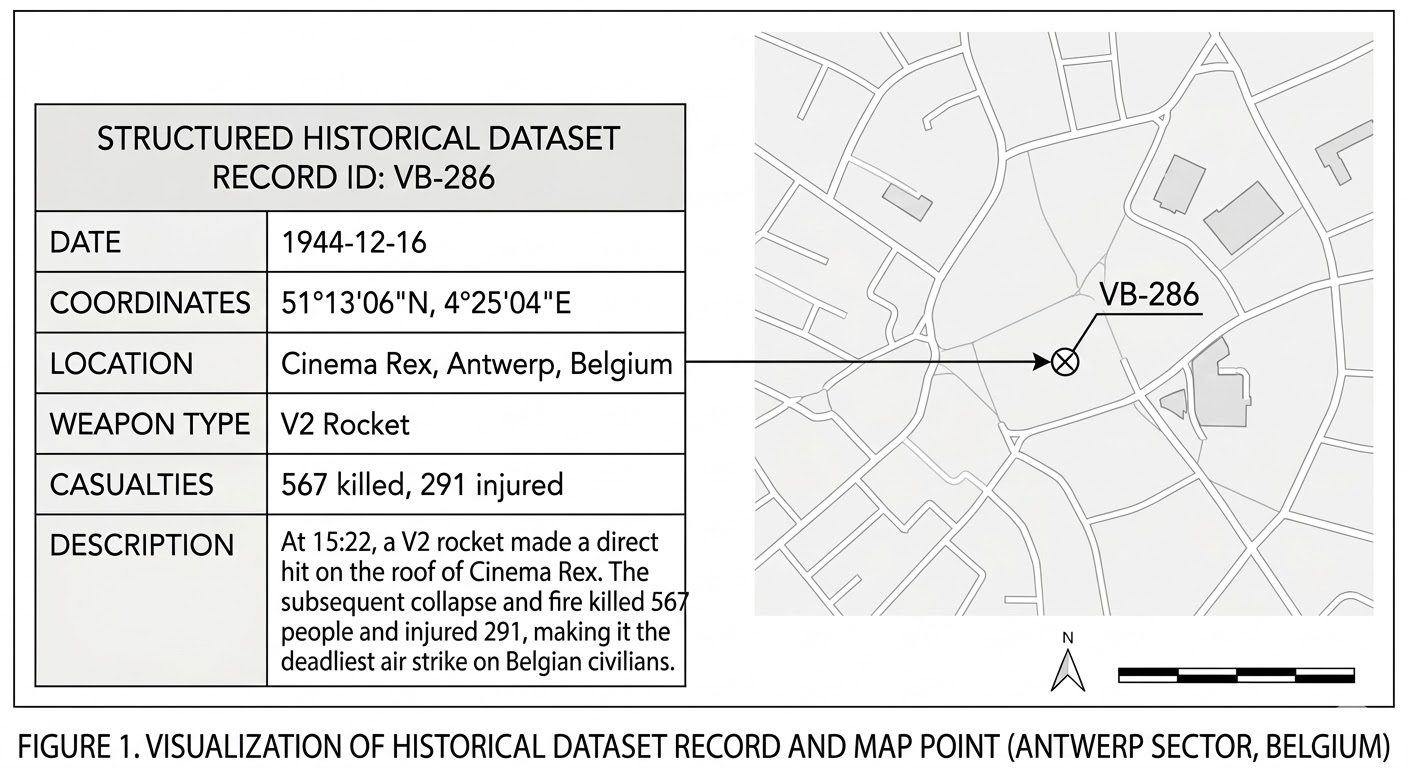
- Date of impact
- Geographic coordinates
- Location description
- Weapon type (if known)
- Casualties and damage notes
- Original narrative text
This step allows records from different archives to be merged into a single structured dataset.
3. Date Parsing and Classification
Dates are standardized into ISO format when possible. Weapon types are detected from source descriptions using explicit rule-based classification so that V-1 flying bombs and V-2 rockets can be distinguished where documentation allows.
4. Casualty and Text Extraction
Narrative descriptions are analyzed to extract casualty counts and supporting details. Where the source text contains information about deaths, injuries, or property damage, these values are recorded in structured fields while preserving the original description.
5. Translation and Review
Many records originate in Dutch-language archival material. These descriptions are translated into English using a local machine-translation model and then reviewed through quality-assurance reports and manual corrections.
Historical Data Enrichment
To improve weapon classification, the dataset is cross-checked against an external historical table of V-weapon impacts compiled by historian Pieter Serrien.
This table is extracted and compared against the master dataset using date and location similarity. Matches are accepted only when the confidence score is clearly higher than competing candidates, preventing ambiguous or conflicting assignments.
This enrichment process significantly increases the number of records where the weapon type (V-1 or V-2) can be identified while preserving uncertain entries as unknown rather than guessing.
Quality Assurance
Each processing stage generates verification tables that allow the dataset to be inspected independently of the map interface. These quality-assurance files review elements such as:
- Date parsing accuracy
- Weapon type classification
- Casualty extraction
- Translation consistency
- Location matching
Manual corrections can be applied to the dataset through a flat CSV file, which is then synchronized back into the GeoJSON records used by the website.
Reproducibility
The dataset used by this website is generated through a scripted processing pipeline. Each stage of the pipeline produces intermediate files and verification tables so that the transformation of the data can be inspected and reproduced.
Because the processing steps are automated, the entire dataset can be regenerated if corrections are made or additional historical sources are incorporated. This approach ensures that updates remain consistent with the methodology described above.
The project therefore treats the dataset as a reproducible research output rather than a manually compiled list of events.
Final Dataset
The website map reads a GeoJSON dataset containing all processed events, while a flat CSV version is maintained for review, editing, and archival reference.
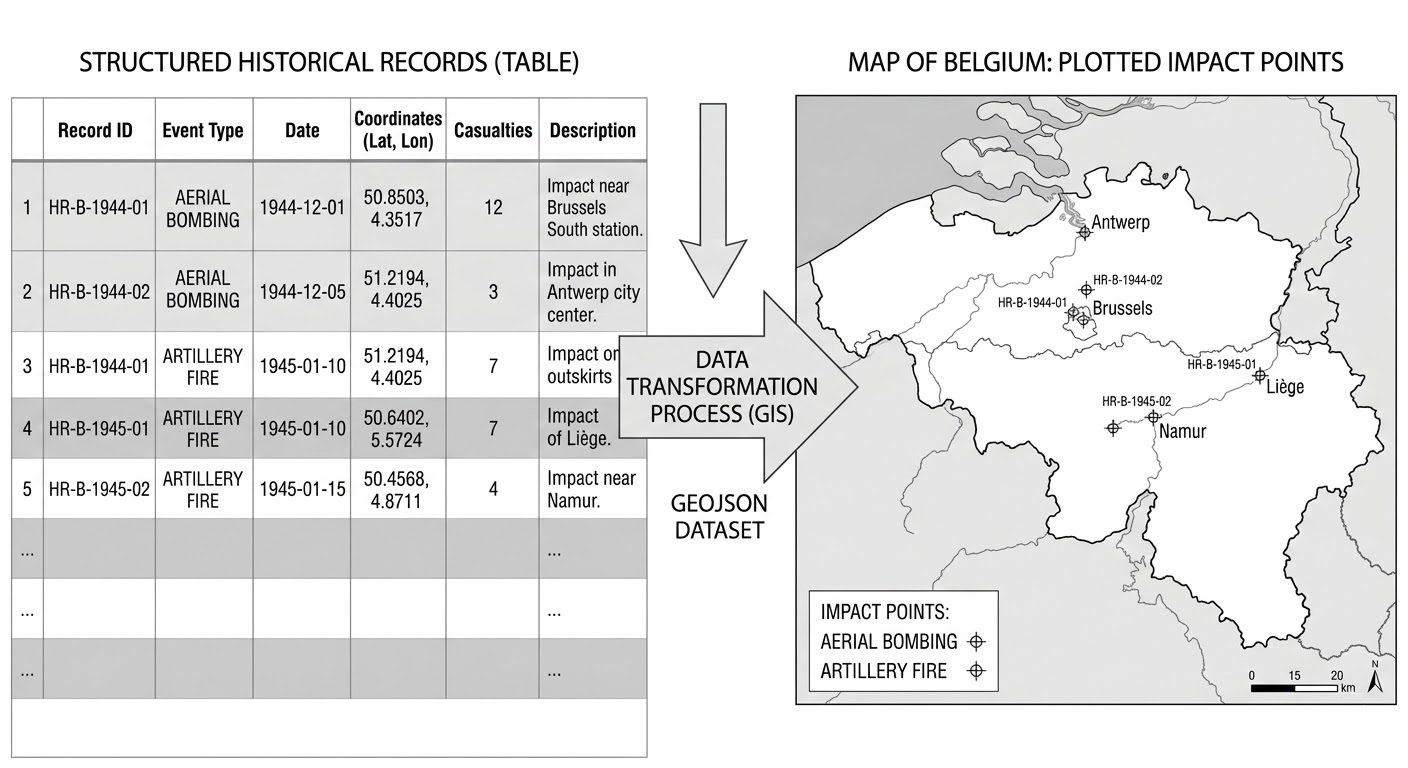
Because the entire dataset is produced through scripted transformations, the pipeline can be rerun when new historical sources become available or when corrections are made to existing records.
Dataset Statistics
The current dataset contains 1,079 recorded V-weapon impact events across Belgium between 1944 and 1945. These records include both V-1 flying bombs and V-2 rockets, although the weapon type is not known for every event.
| Category | Number of Records |
|---|---|
| Total impact records | 1,079 |
| V-1 flying bombs | 365 |
| V-2 rockets | 158 |
| Weapon type unknown | 556 |
Many early records did not explicitly identify the weapon type. Cross-referencing with external historical datasets increased the number of classified events, but a substantial portion remains unidentified in order to preserve historical accuracy.
Data Limitations
The dataset reflects the limitations of the historical records from which it is derived. Some V-weapon impacts are poorly documented, and certain entries lack precise coordinates, weapon classification, or casualty figures.
When the available sources are incomplete or ambiguous, the dataset preserves these uncertainties rather than filling them with assumptions. Fields may therefore remain marked as unknown if the available evidence does not support a reliable conclusion.
Coordinates sometimes represent approximate locations, especially when the original record describes an area rather than an exact impact site.
Sources
The dataset and historical context used in this project draw from several published studies and archival compilations on V-weapon attacks in Belgium, including research by historian Pieter Serrien and contemporary military analyses of the V-weapon campaign.
Additional contextual information about the V-weapon campaign in Belgium was drawn from historical reports, military studies, and museum publications describing the attacks on Antwerp, Liège, Brussels, and other Belgian towns.